Sunday, December 20, 2015

Matra Djet/Jet 6 Mieusset/Pitiot 1967


Drawing/painting of the Matra Djet/Jet VI de Robert "Jimmy" Mieusset/Catherine Pitiot number 100 that took part in the Rallye des Cévennes 1967.

Initially, it was Rene Bonnet who built the first "Djet" cars. When Matra took over production, the cars became known as "Jet". The Matra Djet/Jet was a cool car but it was totally eclipsed by the Alpine Renault A110 "Berlinette", an even cooler car.

Sunday, November 29, 2015

Citroën DS Romãozinho/Bernardo 1972


Oil pastel and colored pencil. This is the Citroën DS 21 Proto Coupé Group 5 number 77 piloted by Francisco Romãozinho and José Bernardo in the 1972 Rallye du Portugal. Visually, the main difference between this proto DS and the factory DS coupé is how the back has been hacked out. Robert Neyret is the guy that took upon himself to shorten (and lighten) the DS 21 to make it more competitive in rally racing. After seeing Neyret's success with his modified DS 21, Citroën decided to build (or have somebody else built) their own prototypes to be used as works (factory) cars by racing crews.

Sunday, October 18, 2015

Datsun 240 Z Mehta/Doughty 1971


This is a sketch of the Datsun (Nissan) 240 Z piloted by Mehta/Doughty at the 1971 Safari Rally.

It's very hard to get the proportions right when doing a perspective drawing of a car. So, I cheat a little by using a rolling ruler which enables me to transfer angles from the reference photo to my drawing paper and a proportional divider which enables me to transfer distances from the reference photo to my paper. Anybody that can sketch/draw without any tool whatsoever is a hero in my book and should be praised to no end.

Saturday, October 17, 2015

Ferrari 625 Maurice Trintignant 1955


This is a graphite pencil drawing of the Ferrari 625 number 14 piloted by Maurice Trintignant at the 1955 Grand Prix of Argentina.

Lancia Stratos Bernard Darniche 1976


This is a graphite pencil drawing of the Lancia Stratos HF Chardonnet number 1 piloted by Bernard Darniche and Alain Mahé at the Rally 4 Regioni in 1976.

Tyrrell François Cevert 1972


This is a drawing of François Cevert in the Tyrrell Ford car number 2 during one of the Grand Prix of the 1972 Formula One season (could be 1971 too).

Sunday, October 11, 2015

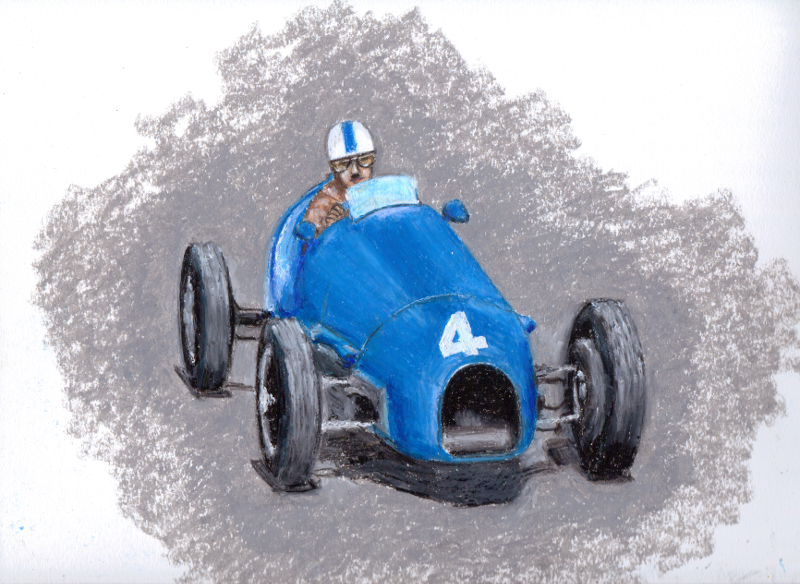
Gordini Maurice Trintignant 1953


This is Maurice Trintignant in its Gordini at the Reims Grand Prix in 1953. The drawing/painting is oil pastel (Pentel) on Stonehenge paper.


This is the the corresponding sketch that I made on drawing paper. I like to draw on drawing paper because it's easy to erase pencil marks. I must admit to using a proportional divider (it looks like a two-ended compass) to get my proportions kinda right. I also use a rolling ruler to get the angles kinda right.

By the way, I can guarantee you that the the fourth wheel is not visible in the reference photo. So no, there's no missing wheel in my drawing.

Porsche 911 T Elford/Stone 1968


This is the Vic Elford/David Stone Porsche 911 T at the Rallye de Monte-Carlo 1968. The painting/drawing is oil pastel (Pentel is the brand) on Stonehenge paper. I used an orange/red stick for the car's local body color and an olive green stick to accentuate the darker shadowy parts. The main issue I had with oil pastel is the tendency for colors that are added on top of another to just slide right over the previous layer, creating a bit of a mess (blobs of pigment instead of a nice layer of color). So, I had to spray workable fixatif a few times during the painting process to get colors to stick on top of each other.


This is the corresponding sketch which I did on drawing paper. I used a light table to transfer the sketch to the Stonehenge paper and then went to town with the oil pastels.

Audi Quattro Michèle Mouton 1981


Michèle Mouton in her Audi Quattro at the Rally de San Remo in 1981.

This is a drawing I made in oil pastel pencils (Pentel is the brand) on watercolor paper. I know a lot of people don't like fixing their pastel drawings/painting but I certainly did (with a workable fixatif by Krylon). I usually make a drawing on drawing paper (to be sure of the proportions), transfer it to a better paper, and then apply colors but since this is such a simple drawing, I didn't bother, I just drew straight on the watercolor paper.

Sunday, May 5, 2013

Alpine Renault A110 Jean-Pierre Nicolas 1973


Ugo Capeto, Alpine Renault A110 Jean-Pierre Nicolas RAC Rally 1973. Faber Castell Pitt artist pens on canvas sheet, 9"x12". ©2013.

This is the Alpine Renault A110 (Berlinette) driven by Jean-Pierre Nicolas at the 1973 RAC Rally. This is an original marker drawing from a photograph whose origin is unknown (if you know the origin, please let me know asap for proper credit).

The 1973 Daily Mirror RAC Rally was part of the 1973 World Rally Championship season. It was run in mid-November in the County of Yorkshire in England. Jean-Pierre Nicolas (with Claude Roure as co-driver) finished the race in 5th position behind three Ford Escort RS1600 and one Volvo 142. Alpine Renault would end up winning the World Rally Championship in this inaugural season with 8 wins in 13 races.

The Alpine Renault A110 (better known as the Berlinette) was built in Dieppe, France from 1962 to 1977. The mechanical parts came from Renault (the "Renault 8", in particular) while the polyester body was originally designed by "Chappe et Gessalin" (on the A108).

Alpine was founded in 1955 by Jean Rédélé, a Renault dealer whose primary interest was to run Renault cars in rally races. The name Alpine is a reference to the rally races run in the Alpes region of France, like the "Critérium des Alpes". In 1973, Alpine was bought by Renault but with Jean Rédélé still in charge.

The Alpine Renault A110 used in the 1973 World Rally Championship was powered by a 1800 cc engine that came from the "Renault 12 Gordini". The rally race engines were prepared by the famous Renault engine guru, Marc Mignotet.

Prints and greeting cards are available at Alpine Renault A110 Jean-Pierre Nicolas 1973 on fineartamerica.com.

Saturday, March 16, 2013

Jaguar E-Type Cunningham/Salvadori 1962


Ugo Capeto, Jaguar E-Type Cunningham/Salvadori Le Mans 1962. Faber Castell Pitt artist pens on canvas sheet, 8"x10". ©2013.

This is the Briggs Cunningham Jaguar E-Type driven by Briggs Cunningham and Roy Salvadori at the 1962 "24 Hours of Le Mans" endurance race. This is an original marker drawing from a photograph in the book "Sports Car Racing, In Camera, 1960-69" by Paul Parker. The artwork is on medium texture Fredrix canvas sheet.

Cunningham and Salvadori finished 4th overall at the 1962 Le Mans endurance race.

Briggs Cunningham was certainly a very rich guy, having inherited a lot of money from his father, who was a successful businessman. Briggs was passionate about sail boat racing (he won the America's Cup in 1958) and sports car racing. Le Mans was probably where he wanted to win the most, maybe to prove to the Europeans that American cars with American drivers could win there. Cunningham got famous at Le Mans in 1950 for his Cadillac based cars that certainly drew attention. One in particular will remain in the annals of Le Mans as probably the weirdest/ugliest looking car ever to run there (nicknamed "Le Monstre" aka "The Monster" by the French). For a while, Cunningham built his own race cars (and production cars for the richer public) in his West Palm Beach factory. It was closed down in 1955. Right at that time (it's probably not a coincidence), he became the official Jaguar distributor for the East Coast and started to use the D-Types and later, the E-Types, for racing purposes. It is said that Briggs Cunningham was the first to paint racing stripes on his cars. The Cunningham "blue on white" stripes, the United States racing colors, would later show up on Caroll Shelby's race cars.

Roy Salvadori raced only twice for team Briggs Cunningham. He's probably best remembered for his victory at Le Mans in 1959 with Carroll Shelby but he was quite the accomplished Formula One driver, having raced at the top level from 1952 to 1962.

Prints and greeting cards are available at Jaguar E-Type Cunningham/Salvadori 1962 on fineartamerica.com.

Friday, November 23, 2012

Ford GT40 Hobbs/Hailwood 1969


Ugo Capeto, Ford GT40 Hobbs/Hailwood 1969. Colored pencil on paper, 9"x12". ©2012.

This is John Wyer Automotive Engineering's Ford GT40 number 23, piloted by David Hobbs and Mike Hailwood at the 1969 Sebring 12 hours endurance race. This is an original colored pencil drawing from a photograph in the book "Sports Car Racing, In Camera, 1960-69" by Paul Parker. The artwork is on Stonehenge archival paper.

The car did not finish the race due to front suspension problems. This late Ford GT40 was powered by the 4.9 liter (302 cubic inch) Ford V8 engine.

The story of the Ford GT40 is said to have started after the failed attempt by Ford to buy Ferrari in the summer of 1963. Not being overly happy by this mishap, Henry Ford II decided he would build a car that would beat the Ferraris in their own backyard, the European endurance race tracks with Le Mans (at the 24 Hours) being the ultimate prize.

It took a few years for the Ford GT40 to win at Le Mans but the success was total with a 1-2-3 finish in 1966 (Mc Laren/Amon, Miles/Hulme and Bucknum/Hutcherson). The Ken Miles/Denny Hulme should have won the race but since the three cars crossed the finish line at the same time (for an historic photo op), it's the car that started the further back from the starting grid that won. The engines on those 1966 cars were the big 7 liter (427 cubic inch) Ford V8s.

The name Ford GT40 is not an official name, Ford GT definitely is though. The GT40 moniker was given by the British press because of the height of the car, which happens to be 40 inches. The moniker kinda stuck and the Ford GT40 made history.

Prints are available at Ford GT40 Hobbs/Hailwood 1969 on fineartamerica.com.

Saturday, September 15, 2012

Porsche 917K Pedro Rodriguez 1970


Ugo Capeto, Porsche 917K Pedro Rodriguez 1970. Colored pencil on paper, 6"x10.5". ©2012.

Pedro Rodriguez in a Porsche 917K at the 1970 Brands Hatch 1,000 kilometres endurance race. This is an original colored pencil drawing from a photograph in the book "Sports Car Racing, In Camera, 1970-79" by Paul Parker. The artwork is on Stonehenge archival paper.

Pedro Rodriguez was paired with Leo Kinnunen in a John Wyer Porsche 917K at Brands Hatch 1970. The race was run (mostly) in very wet weather. At one point, a flag went up signaling the drivers to slow down and not overtake but Pedro didn't see it and passed several cars. He got black flagged into the pits because of that and he went from an ill-acquired 2nd place to a 12th. Upon returning to the track, Pedro drove like mad in the rain, went up the field of cars ahead of him, and took the lead, which he lost at the driver switch. Eventually, Pedro won the race five laps in front of a Salzburg Porsche 917K.

Prints are available at Porsche 917K Pedro Rodriguez 1970 on fineartamerica.com.

Saturday, September 1, 2012

Ferrari 512S Mario Andretti 1970


Ugo Capeto, Ferrari 512S Mario Andretti 1970. Colored pencil on paper, 6"x10". ©2012.

Mario Andretti in a Ferrari 512S at the 1970 "Sebring 12 Hours" endurance race. This is an original colored pencil drawing from a photograph in the book "Sports Car Racing, In Camera, 1970-79" by Paul Parker. The artwork is on Stonehenge archival paper.

Mario Andretti was paired with the Italian Arturo Merzario in that race. They started in pole position, cruised along in first place for quite a while, but suffered a gearbox failure after 10 hours. Everybody thought that was it for Mario, even Mario itself, but no, as Andretti was asked to finish the race in the Ferrari number 21 driven by Nino Vaccarella and Ignazio Guinti when the lead Siffert/Redman Wyer Porsche 917 had to pitstop due to mechanical problems. The only thing between Andretti and the prize was the Steve McQueen/Peter Revson Porsche 908 spider. Thanks to an incredible finish and Peter Revson's probable state of exhaustion (he did most the driving because McQueen had one foot in a cast), Mario overtook the Porsche 908 and won the race.

The Ferrari 512S had an all-alloy V12 engine of almost five liters (550 hp at 8500 rpm). It was built both as a berlinetta (closed top) and a barchetta (open top spider). It took part in the Manufacturers’ World Championship in 1970 and 1971, mostly battling with the mighty Porsche 917s.

Prints are available at Ferrari 512S Mario Andretti 1970 on fineartamerica.com.

Thursday, August 23, 2012

Ferrari 312P Pedro Rodriguez 1969


Ugo Capeto, Ferrari 312P Pedro Rodriguez 1969. Colored pencil on paper, 4"x7.5". ©2012.

Pedro Rodriguez behind the wheel of the Ferrari 312P at the 1969 "1,000 kilometers of Monza" endurance race. This is an original colored pencil drawing from a photograph in the book "Sports Car Racing, In Camera, 1960-69" by Paul Parker. The artwork is on Stonehenge archival paper.

The number 2 Ferrari 312P (driven by Pedro Rodriguez and Peter Schetty) did not finish the race as it was put out of commission (accident) after 66 laps. The other 312P that was entered did not finish either (piloted by Mario Andretti and Chris Amon). Disappointment for Ferrari as both cars had done very well in qualifying (pole and 3rd on the starting grid).

Pedro Rodríguez (1940-1971) was a Mexican sports car racing driver. He is probably best remembered for his victory at Le Mans in 1968 with Belgian driver Lucien Bianchi in a John Wyer Gulf Ford GT40. He was the older brother of Formula One Ferrari driver Ricardo Rodríguez (1942-1962).

The Ferrari 312P was a two-seater fitted with a 3.0 liter engine (420 hp at 9800 rpm). It was initially a barchetta (open top) but it soon became a berlinetta (closed top) for the 1969 "24 Hours" at Le Mans. Ferrari abandoned the Ferrari 312P at the end of the 1969 season to focus on the new 5 liter V12 Ferrari 512.

Prints are available at Ferrari 312P Pedro Rodriguez 1969 on fineartamerica.com.

Maserati 250F Juan Manuel Fangio 1958


Ugo Capeto, Maserati 250F Juan Manuel Fangio 1958. Colored pencil on paper, 7"x10". ©2012.

Juan Manuel Fangio in a Maserati 250F at the Reims French Grand Prix in 1958, a race he finished 4th behind Mike Hawthorn and Stirling Moss. This is an original colored pencil drawing from a photograph in the book "Formula 1, In Camera, 1950-59" by Paul Parker. The artwork is on Stonehenge archival paper.

The Maserati 250F was a single seater with a 2.5 liter straight-six engine (240-270 bhp at 7,200-8,000 rpm). Later models were fitted with a V12.

Juan Manuel Fangio won the Formula One World championship title five times, in 1951, 1954, 1955, 1956, and 1957. The 1958 French Grand Prix was actually his last race.

Prints are available at Maserati 250F Juan Manuel Fangio 1958 on fineartamerica.com.

Cooper T51 Stirling Moss 1959


Ugo Capeto, Cooper T51 Stirling Moss 1959. Colored pencil on paper, 7"x9". ©2012.

British driver Stirling Moss driving a Cooper T51 at the 1959 Monza Italian Grand Prix, a Formula One motor race that he ultimately won for the privateer Rob Walker Racing Team. This is an original colored pencil drawing from a photograph in the book "Formula 1, In Camera, 1950-59" by Paul Parker. The artwork is on Stonehenge archival paper.

The Cooper T51 was powered by a 2.5-liter 4-cylinder inline engine (240 bhp at 6,750 rpm) made by Coventry Climax. It was rear-engined, an engine position the Cooper Car Company introduced in Formula One in 1955. Stirling Moss' win in Argentina in 1958 with a Vanwall Cooper T45 was the first win for a rear-engined car in Formula One history.

The Rob Walker Racing Team was founded by Rob Walker, heir to the Johnnie Walker whisky family.

Surprisingly, Stirling Moss, despite all his successes, never won a Formula One World Championship.

Prints are available at Cooper T51 Stirling Moss 1959 on fineartamerica.com.

Wednesday, August 22, 2012

Ferrari 335S Mike Hawthorn 1957


Ugo Capeto, Ferrari 335S Mike Hawthorn 1957. Colored pencil on paper, 6"x9". ©2012.

Mike Hawthorn driving a Ferrari 335S at Le Mans in 1957. This is an original colored pencil drawing from a photograph in the book "Sports Car Racing, In Camera, 1950-59" by Paul Parker. The artwork is on Stonehenge archival paper.

At the 1957 "24 Hours of Le Mans", the world's oldest active sports car race in endurance racing, Mike Hawthorn (1929-1959) was teamed up with Luigi Musso, an Italian racing driver, for the Scuderia Ferrari (Ferrari factory team). The Ferrari 335 Sport they were driving suffered a blown engine after 56 laps forcing the retirement of the Anglo-Italian duo from the race.

The Ferrari 335 Sport is the successor to the Ferrari 315, with a more powerful V-12 engine (4.023 liters, 390.0 bhp @ 7800 rpm). It is a spider/spyder (open two seater sports car) with a body designed and built by Carrozzeria Scaglietti.

Prints are available at Ferrari 335S Mike Hawthorn 1957 on fineartamerica.com.